


Builders Brief is a weekly letter for people building something next to a full life: a job, a family, more ideas than hours. I’m am not writing from the top. I’m writing from the middle.
This post may be too long for email, read online for the best experience.
If this was forwarded to you, consider subscribing for future posts.

You don't need more information.
It's the one thing I realized when thinking back to where I started in early 2023.
We had just gotten the news that we were going to be parents. My goal then was to create the optimal environment. Meaning working on stuff I truly care about and making money doing so in order to slowly quit my day job to spent more time with my family.
Three years passed. I started countless projects and stuck with none of them. Mostly because I tried to undo the lack of taking action by taking massive action and trying to take in as much information as possible.
I used to watch countless videos, read books and articles or listen to podcasts, only to do nothing with the information I stuffed into my brain.
And I think I am not alone with this.
For me it feels like fueling a car until it's full and then some, only to keep it standing at the gas station waiting for better fuel or the perfect moment to start driving.
But both never come.
A full tank
We need information to get anything started or make progress.
There is no way around it, otherwise we would try the same methods over and over again expecting different outcomes each time.
But at some point you gather too much data, so you lose sight of what truly matters.
You lose the plot.
You know this feeling when you talk to your oversharing friend? When you at some point in the conversation just zone out because you don't even remember why you are having this conversation. It's not that you don't care. It just gets too hard to follow since there is just too much to process. So you shut down and let your mind wander. In these moments you lose the plot.
The thing with modern society is that we reached this point years ago.
We get drawn into drama, news, debates etc all the time but social media made it worse 100x.
In 2008 a UCSD study found the average American took in about 100,500 words a day across 12 hours of media. That's close to a whole book every day. Think about it for a second. A whole book next to your job, going to the gym and family. Then think about how much it must be today, with smartphones and social media running our lives 24/7. It's absurd.
Most people think that more is better.
But this could not be further from the truth. More input does not mean more output. Nor output of higher quality. It means more is thrown away. Because you can only handle so much information. You have a certain bandwidth, and everything that exceeds it is noise that gets thrown out the window.
These are the moments you run on overload and feel easily overwhelmed. Because there is no room to process the information thrown at you.
That's what the famous study by Iyengar & Lepper in 2000 showed. A store showed 24 jams one day and 6 jams another day. The big table drew more people, but only about 3% bought anything. With 6 jams, about 30% bought.
More options. Less action.
Busy is not moving
But here is the tricky part.
Less action rarely looks like doing nothing.
When our system runs on overload, we have two ways out.
We can either freeze up.
Or we keep ourselves busy.
Freezing is easy to spot.
You feel stuck and you know it.
Staying busy is the dangerous one. Because it feels like the opposite of being stuck.

Let me show you what I mean.
It's 8:30 pm. The kids are finally asleep. You open the laptop to work on your thing. Maybe it's the first article for your newsletter. Maybe it's the landing page for your product.
You write two lines. Then you hit the hard part. The part where you actually have to decide something.
Ten seconds later you are on YouTube watching "How to write the perfect landing page".
One video becomes three. You take notes. You save a thread on X for later. At 10:15 you close the laptop and go to bed.
And you feel good about it. You learned something. You worked on your business tonight. Right?
Answer this honestly: when the hard part shows up, do you push through, or do you go straight to something more enjoyable that still feels productive?
I did the second one for years.
Countless times I found myself scrolling through X or watching YouTube videos to find a way around the discomfort.
The worst part is that this still feels productive.
Cal Newport has a name for this.He calls it pseudo-productivity: the use of visible activity as the primary means of approximating actual productive effort.
He wrote it about office jobs. Emails, meetings, looking busy. But it fits our evenings just as well. A saved post looks like progress. A finished course looks like progress. A full notes app looks like progress.
Here is a simple test. At the end of the evening, ask yourself: what exists now that didn't exist two hours ago?
A paragraph. A page. A message to a customer. Anything you made counts. Notes on how other people do it don't
Back then, most evenings my answer was nothing.
I filled the tank every evening and called it driving.
A dozen books deep
Alex Hormozi, Dan Koe, David Senra or Chris Williamson.
One thing all of them have in common — I watched hours of their content and read so many posts and newsletters I can't even count them.
Over the years it must have been 15 times the length of all three Lord of the Rings movies and about the words of dozen of 500-page books.
I was desperately trying to absorb as much information as possible to get me anywhere close to my dream life. A life where money would be abundant and I would never have to scrape my way through the last week before the next paycheck came in.
It is 2023 and I just realized I lost valuable years I could have used to build skills and, first and foremost, leverage.
I played video games every free minute I had for years, only dreaming about what I would do if I had as much money as I wanted. I visualized what cars I would drive. What places I would visit. Only to wake up to the reality that my current path would fall a few hundred miles short of that goal and fantasy.
So to make up for lost time, I went on a spree, collecting as many ideas and as much information as possible.
I got obsessed with self improvement and read everything from Robert Greene, Cal Newport, David Goggins and a lot more. Listened to all sorts of business and personal development podcasts.
I wanted to change so badly.
I was sick of my current situation.
But underneath all of it was a belief I didn't see back then. I thought I needed to learn and know more before I was allowed to get started.
That I had to earn it by learning everything possible first.
I call this the permission trap.
And to be honest, I still catch myself in it.
Every time I want to make the next step, a small voice tells me to watch one more video first. Read one more article or book, so I don't make any mistakes.
The permission trap
The permission trap feels like the smart move.
It feels responsible.
You tell yourself you are preparing.
But it's an irrational fear, and it's simply not true. Nobody is going to hand you the permission. You are waiting for a signal that never comes.
The best of the best don't work like that. They take action with only the core information they need. When they need to know something, they learn it and move on.
Pieter Levels, better known as levelsio, is a good example. He built a whole list of profitable products mostly on his own. In his book MAKE he writes that you should not learn through courses or bootcamps. You start, and whenever you hit something you don't know, you look it up and keep going.
He also launches before things are ready, then keeps launching.
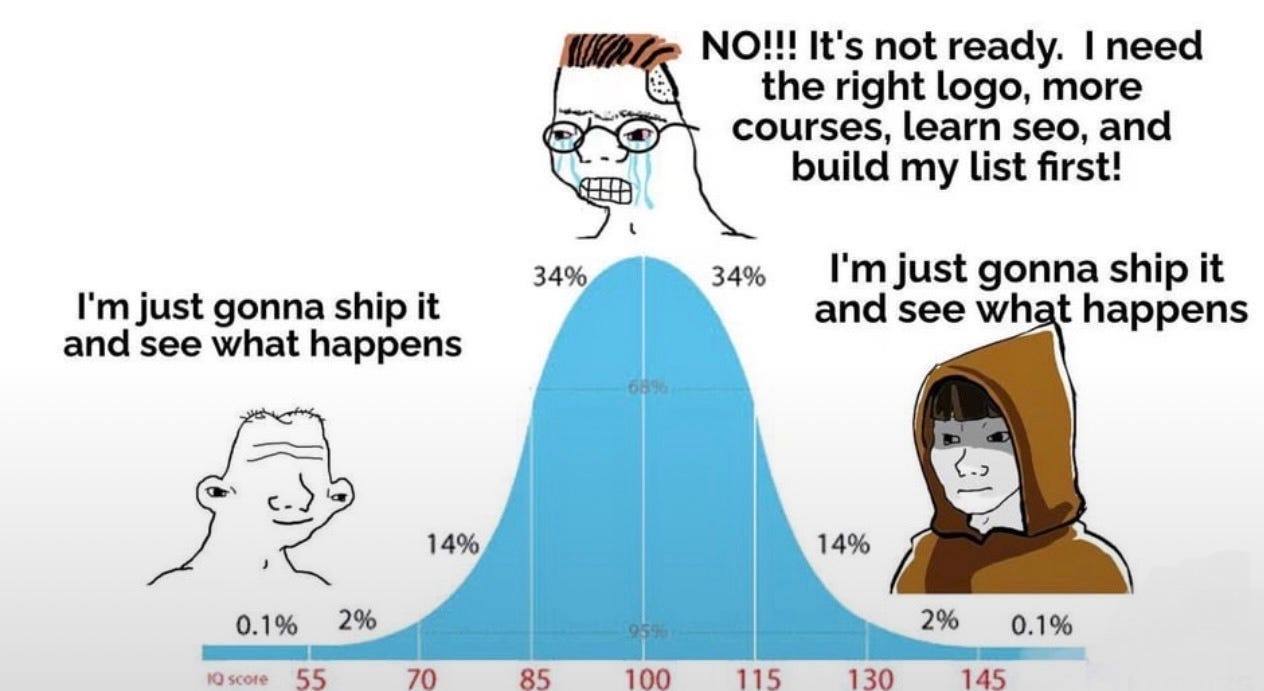
This is where the permission trap and pseudo-productivity meet.
Every course, every video, every saved post feels like you are earning your permission.
It's visible activity.
It looks like progress. And the car is still standing at the gas station.
Here is the thing. Your tank is already full. It has been for a long time.
Learn it when you need it
I have about six hours a week. Two for writing, four for building. That's not enough time to learn everything first, so I stopped trying. Here is what I do instead.
Pick the next step
I don't plan the whole road anymore. I ask one question: what is the next step? Not the next ten. Just one.
Learn only what that step needs
When I built my deep work tool with Claude Code, I didn't take a coding course first. I worked on it 60 minutes a day and looked things up the moment I got stuck. Then I closed the tab and kept building.
Ship before it feels ready
There is always one more thing to tweak. Don't bother. You can always make changes afterwards.
I still learn. I love it. But now it has a job. It has to turn into something.
Leave the gas station
If you have a 9-5 and kids, your time is the scarcest thing you have. Don't spend the next 12 months filling a tank that's already full.
Try this for one week.
Write down the next step you keep avoiding. Then write down the one thing you would need to know to do it. Learn only that. Then do the step.
You already have permission.
You don't need more information.
— Chris